DIY Homeowner Guide
How to Change Your AC Filter
Changing your filter is the easiest and cheapest thing you can do for your AC. It takes five minutes, needs no tools, and prevents a long list of expensive problems. Here is how to do it right, plus the MERV mistakes that quietly choke systems.
By Brentwood HVAC Repair Pro · Published · Brentwood, TN
Same-day appointments · 24/7 emergency help in Brentwood, TN
 Brentwood’s Heating & Air Pros
The straight answer: find the filter, note the size printed on its frame, buy the same size, and slide the new one in with the airflow arrow pointing toward the blower. Do it every 1 to 3 months during cooling season. In Middle Tennessee, the honest version of the schedule is to check the filter every month and change it when it looks dirty, because pollen season, pets, and nearby construction on corridors like Franklin Rd can clog a filter in weeks rather than months.
Step 1: Find Your Filter
The filter sits somewhere in the return-air path, and in Brentwood homes there are a few common spots. Check the return grille in the hallway or wall first: many grilles have a filter right behind them. If there is no filter there, look at the indoor air handler in the attic, closet, or garage for a filter slot or a filter cabinet, sometimes a thicker 4-inch media cabinet. Larger homes often have two or three returns, one per floor, and every one of them needs a filter. If you find only one return serving a 4,000-square-foot two-story, make a note of it: that is worth mentioning to a technician, because undersized returns cause the same airflow problems a dirty filter does.
Step 2: Get the Right Size and Type
Pull the old filter out and read the size printed on the frame, something like 20x25x1. That is the nominal size; buy the same nominal size and it will fit. Now the part that matters: the MERV rating. MERV tells you how fine the filtration is, from MERV 1 up to 16. For most homes, MERV 8 to 11 is the sweet spot, good particle capture without choking airflow. Thick 4-inch media filters in a proper cabinet give you high filtration with very little restriction and only need changing once or twice a year. Cheap fiberglass filters (MERV 1 to 4) protect the equipment but do almost nothing for your air.
Step 3: Swap It Safely
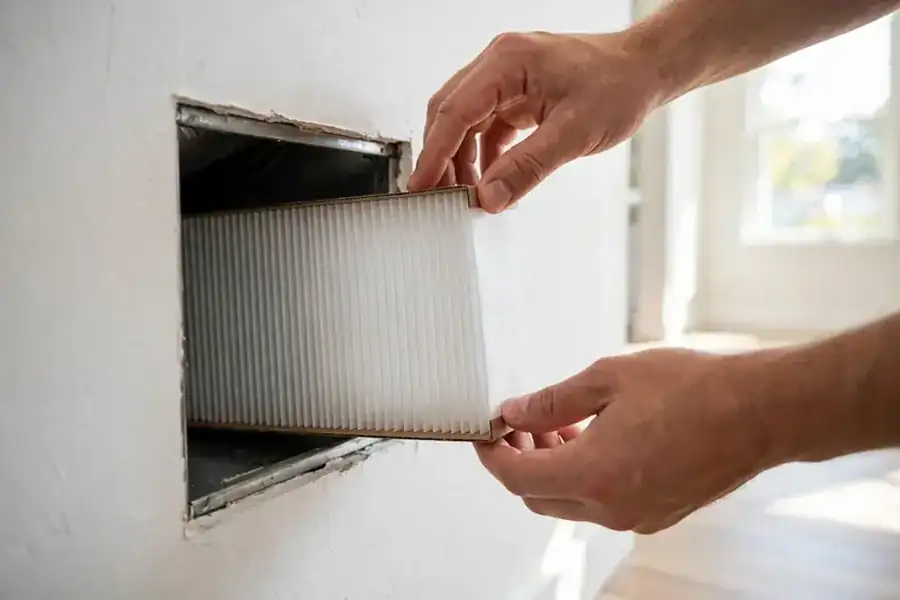
Turn the thermostat to OFF first so the blower is not pulling air while you work. Pull the old filter straight out and note which way the airflow arrow points: toward the blower or furnace, away from the return grille. Unwrap the new filter, slide it in with the arrow pointing the same direction, and close the grille or cabinet door firmly. If the door or grille does not close cleanly, the filter is the wrong size, not a close-enough size. A filter that rattles or leaves gaps lets dirty air bypass it entirely, which defeats the purpose. Write the date on the filter frame with a marker so you know when you last changed it.
MERV Mistakes That Choke Your System
| Mistake | Why it hurts | Do this instead |
|---|---|---|
| Jumping to MERV 13 on a standard system | Dense media restricts airflow the system was not designed for, freezing the coil | Stay at MERV 8 to 11, or ask a tech to check static pressure first |
| Leaving a 1-inch filter in for six months | Thin filters load up fast and choke airflow long before they look dramatic | Check monthly in cooling season, change when dirty |
| Forgetting one of several returns | One clean filter cannot fix two dirty ones; the system still starves | Change every filter in the house the same day |
| Installing it backwards | The arrow supports the media; backwards filters collapse and bypass air | Arrow always points toward the blower |
| Wrong nominal size, forced to fit | Gaps around the edges let unfiltered air straight to the coil | Buy the exact size printed on the old frame |
Your Questions, Answered
How often should I change my AC filter?
Every 1 to 3 months during cooling season in Middle Tennessee, more often if you have pets, allergies, or live near construction. The honest answer is to check it monthly and change it when it looks dirty, rather than following a rigid calendar.
What MERV rating should I use in my home?
For most Brentwood homes, MERV 8 to 11 is the sweet spot: good filtration without choking airflow. MERV 13 can work if your system and ductwork were designed for it. If you are unsure, a technician can check your system's static pressure with the new filter installed.
Can a filter be too good for my system?
Yes. A very dense filter on a system that was not designed for it restricts airflow, which can freeze the evaporator coil, strain the blower motor, and raise energy bills. Thicker 4-inch media filters are the safe way to get high filtration without the restriction.
My home has more than one return. Do I change all the filters?
Yes. Every return grille or filter cabinet in the system needs a clean filter. Larger Brentwood homes often have two or three returns, and changing only one leaves the rest choking the system. Write the date on each filter so you remember them all.
Will a dirty filter actually damage my AC?
It can. Restricted airflow freezes the evaporator coil, overheats the blower motor, and in extreme cases lets unfiltered air bypass the filter and foul the coil itself. A dirty coil is far more expensive to clean than a filter is to replace.