Troubleshooting Guide
AC Won't Turn On? Here's What to Check
A dead AC on a hot day feels like an emergency, but the cause is often something simple and safe to check yourself. Run this 10-minute checklist before you call. It fixes more dead systems than you would expect.
By Brentwood HVAC Repair Pro · Published · Brentwood, TN
Same-day appointments · 24/7 emergency help in Brentwood, TN
 Brentwood’s Heating & Air Pros
When an AC will not turn on at all, the short answer is that power or the control signal is not reaching the equipment. In order of likelihood for Brentwood homes: a mis-set thermostat, a tripped breaker, dead thermostat batteries, a condensate float switch tripped by a clogged drain line, or a failed capacitor or contactor. The checklist below walks you through the safe checks in the right order. It takes about ten minutes, and it resolves a surprising number of the no-cool calls we get.
The 10-Minute Safe Checklist
Do these in order. Stop at the step that brings the system back to life, and call us if you reach the end with a still-dead unit.
- Thermostat: confirm it is set to COOL, fan on AUTO, and the set point is well below the room temperature. Replace the batteries even if the display looks fine. Weak batteries cause more blank-screen calls than anything else.
- Breaker panel: find the AC or HVAC breaker and flip it fully to OFF, then back to ON. Breakers sometimes sit in a half-tripped position that looks fine at a glance.
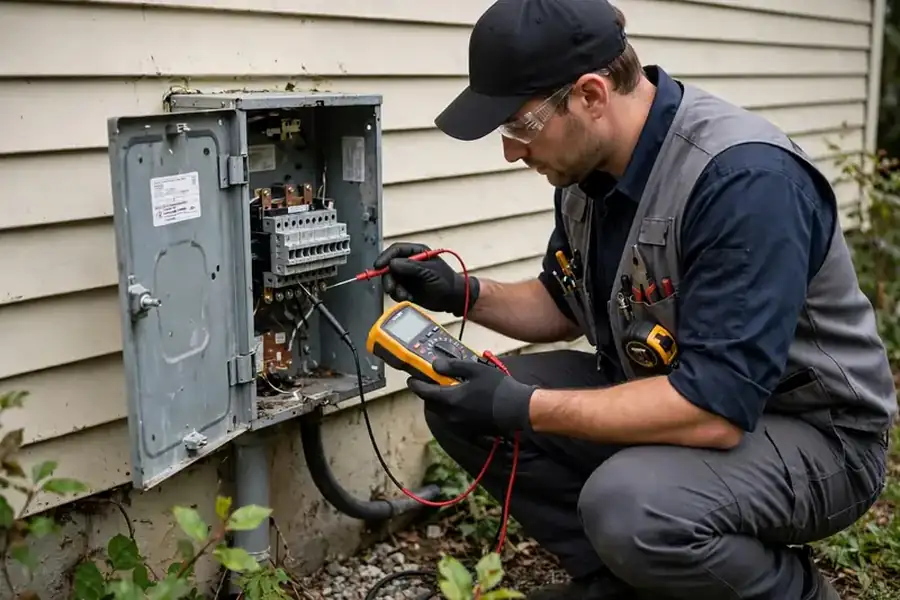
- Outdoor disconnect: there is a gray disconnect box on the wall by the condenser. Make sure the switch or pull-out is seated in the ON position.
- Float switch: look at the indoor air handler, usually in the attic or a closet. If you see a small device on the drain line or pan with the float raised, the drain is clogged. Clear visible sludge from the drain line exit outside, then reset.
- Listen: with the thermostat calling for cooling, go outside and listen at the condenser. A humming unit with a still fan points to a failed capacitor. Total silence points to a control or power issue.
The Float Switch Most Homeowners Don't Know About
This one deserves its own section because it surprises people. Your AC wrings gallons of water out of the air on a humid Tennessee day, and all of it drains through a condensate line. When that line clogs with algae and sludge, water backs up into the pan, and a little float switch kills the system to protect your ceiling. In Brentwood's bigger homes, the air handler often sits in the attic, so the float switch is doing serious duty: a pan overflow up there ruins drywall fast. If your system mysteriously dies on the hottest, most humid days and works fine after a technician visit, a clogged drain tripping the float switch is the likely story. Pouring a cup of plain white vinegar down the drain line's access port each month during cooling season helps keep it clear.
What We Check When the Basics Don't Work
When the safe checklist does not revive the system, the problem is electrical or mechanical, and that is pro territory. On a no-start call we check the capacitor with a meter under load, test the contactor, verify 24-volt control voltage at the thermostat and the board, inspect the wiring and connections for heat damage, and confirm the compressor is not grounded or locked. We also check the float switch circuit and the condensate drain, because a system that died from a clogged drain looks identical to one that died electrically. Every finding gets explained in plain language before any repair starts, and you get a firm price up front.
When a Dead AC Is an Emergency
| Situation | What it means | What to do |
|---|---|---|
| Indoor temperature climbing past 85, vulnerable people home | Heat risk for the elderly, infants, or anyone heat-sensitive | Call our 24/7 emergency line right away |
| Burning smell from vents or equipment | Possible electrical fault or overheating motor | Turn the system off at the thermostat and breaker, then call |
| Breaker trips again after one reset | Short or failing component | Leave the breaker off and call for service |
| System dead but the house is still comfortable | Annoying, not dangerous | Run the checklist, then schedule a same-day visit |
| Water under or around the indoor unit | Clogged drain or frozen coil melting | Turn the system off, mop up, call before restarting |
Your Questions, Answered
Why won't my AC turn on at all?
The most common reasons are a mis-set thermostat, a tripped breaker, dead thermostat batteries, a float switch tripped by a clogged condensate drain, or a failed capacitor or contactor. Work through the safe checklist in this guide before calling; it resolves a surprising number of no-cool calls.
My thermostat screen is blank. What does that mean?
A blank screen usually means the thermostat has no power. For battery models, replace the batteries first. If that does not help, the low-voltage circuit may have lost power, which can happen when the float switch trips on a clogged drain or a fuse blows on the air handler control board.
The breaker is fine but the outside unit is dead. Why?
Power reaches the condenser through a disconnect box by the unit, and control signals come from the thermostat. A failed capacitor, a bad contactor, or a broken thermostat wire can all leave the outdoor unit silent while the breaker looks fine. These are electrical repairs for a technician.
What is a condensate float switch?
It is a small safety device on the condensate drain line or drain pan that shuts the system off when water backs up. It prevents ceiling damage from an overflowing pan. A clogged drain line in a Tennessee summer can trip it often, which is why the system mysteriously stops on the hottest days.
Should I reset the breaker more than once?
Reset it once, carefully. If it trips again, leave it off and call a professional. A breaker that keeps tripping usually signals a deeper electrical issue, and repeated resets risk damaging the compressor or starting an electrical problem that is far more expensive than the original repair.